
Addressing Significant, Growing Unmet Needs in MASH
Metabolic Dysfunction-Associated Steatohepatitis (MASH) is a serious, chronic liver disease that is driven by excess liver fat and inflammation. MASH is caused by an accumulation of excess fat in the liver (steatosis), which can lead to chronic inflammation and scarring (fibrosis). There is a significant, growing unmet need for new therapies that address both hepatic and systemic metabolic dysfunction.
MASH – A Serious, Chronic Disease
- Significant Epidemiology: MASH is estimated to affect over 5% of the U.S. adult population.1 The prevalence of MASH in the U.S. and worldwide is expected to continue to increase with the global rise of cardiometabolic disease.2
- Underdiagnosed, Undertreated Disease: MASH is a serious disease that is underdiagnosed and undertreated, with only two currently approved therapies. With increased disease awareness and non-invasive screening techniques (versus biopsies) MASH diagnosis rate is expected to double over the next decade3.
- Serious Medical Consequences: Left untreated, MASH often progresses to cirrhosis, liver failure, hepatocellular carcinoma, liver transplantation, and premature death. MASH is currently the leading driver of liver transplantations and a primary risk factor for hepatocellular carcinoma2.
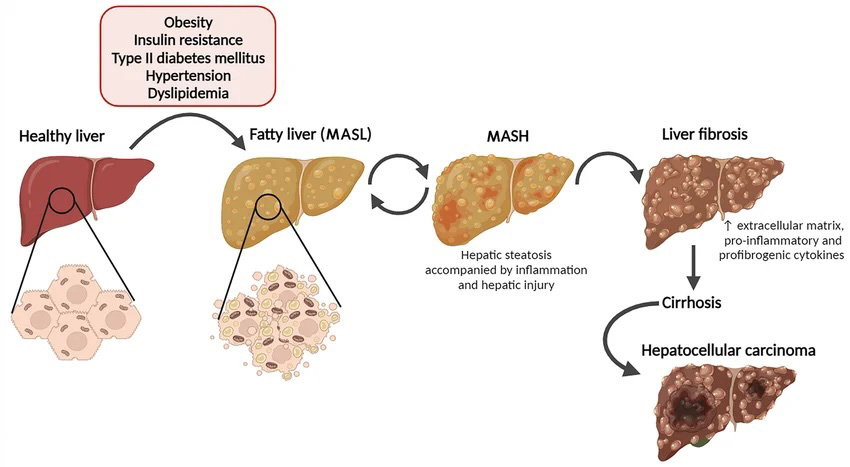
Svobodová G, Horní M, Velecka E, Boušová I. "Metabolic dysfunction-associated steatotic liver disease-induced changes in the antioxidant system: a review." Archives of Toxicology 99(1):1–22 (2024). https://doi.org/10.1007/s00204-024-03889-x. Licensed under CC BY 4.0: https://creativecommons.org/licenses/by/4.0/
MASH is Driven by Metabolic Dysfunction
MASH is a serious, chronic liver disease. Under normal conditions, the liver acts like a sorting facility for the energy we get from food – converting nutrients into sugar and fatty acids to fuel other parts of the body. In a healthy state, the liver should contain only a small amount of fat and the vast majority of the body’s excess energy is sent to adipose tissue (fat cells) for long-term storage. In individuals living with chronic obesity, the adipose can become dysfunctional and excess fat can accumulate in organs, such as the liver. Excess liver fat causes oxidative stress and inflammation, which eventually leads to the liver damage and fibrosis associated with MASH.
MASH Needs New Treatment Options
We are developing HU6, a potential best-in-class MASH therapy that is uniquely positioned to address this chronic liver disease. HU6 is advancing in the AMPLIFY Phase 2 trial for MASH.
In prior clinical trials, HU6 resulted in robust liver-centric effects, with reductions in fat and inflammation (the primary drivers of MASH), along with systemic reductions in fat (particularly visceral fat) while preserving muscle, which is critical for sustained metabolic health.
HU6 leverages an energy expenditure mechanism to deliver differentiated cardiometabolic health benefits to MASH patients. HU6 increases energy expenditure through mitochondrial uncoupling, a natural metabolic process responsible for 20-40% of average daily energy expenditure. By increasing mitochondrial uncoupling, patients burn additional calories, primarily from fat, even while at rest. HU6 is metabolized in the liver to provide liver-targeted reductions in fat and inflammation, the primary drivers of MASH.
Learn more about our ongoing HU6 AMPLIFY Phase 2 clinical trial
.png)
Read more about our HU6 results in MASH, including our M-ACCEL Phase 2 data presented as an oral, late-breaker presentation at AASLD 2025
References
1 Le P, Tatar M, Dasarathy S, et al. Estimated Burden of Metabolic Dysfunction-Associated Steatotic Liver Disease in US Adults, 2020 to 2050. JAMA Netw Open. 2025;8(1):e2454707. Published 2025 Jan 2. doi:10.1001/jamanetworkopen.2024.54707.
2 Younossi ZM, Kalligeros M, Henry L. Epidemiology of metabolic dysfunction-associated steatotic liver disease. Clin Mol Hepatol. 2025;31(Suppl):S32-S50. doi:10.3350/cmh.2024.0431.
4 Lazarus J, Brennan P, Mark H et al. A call for doubling the diagnostic rate of at-risk metabolic dysfunction-associated steatohepatitis. The Lancet Regional Health – Europe, 2025; 54.
Contact Us
For general inquiries please e-mail us at info@rivuspharma.com.