
Our focus is on advancing HU6 in the ongoing AMPLIFY Phase 2 trial for MASH. Our pipeline also includes RV-8451, in IND-enabling studies for obesity.
POTENTIAL BEST-IN-CLASS ORAL MEDICINES FOR CARDIOMETABOLIC DISEASE
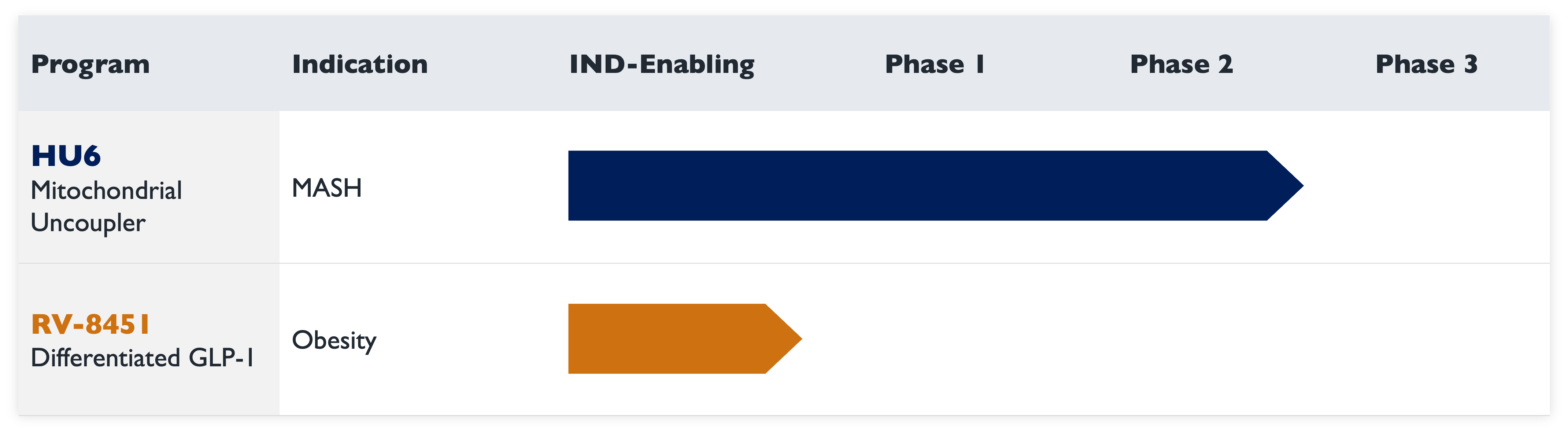
MASH – Metabolic dysfunction-associated steatohepatitis
GLP-1 – Glucagon-like peptide-1 (receptor)
HU6 - Potential Best-in-Class Oral Therapy for MASH
- Differentiated Approach: HU6 is a potential best-in-class oral MASH therapy uniquely positioned to address the underlying causes of this disease.
- Promising Efficacy Profile: In prior trials, HU6 resulted in robust liver-centric effects, with reductions in fat and inflammation (the primary drivers of MASH), along with systemic reductions in fat (particularly visceral fat) while preserving muscle, which is critical for sustained metabolic health.
- Favorable Safety Profile: With over 500 patients treated to date, HU6 has demonstrated a positive safety and tolerability profile.
- Prominent Presentations: HU6 clinical results have been published in The Lancet Gastroenterology & Hepatology for MASLD, presented in a late-breaker oral presentation at AASLD for MASH, and published in JAMA Cardiology for HFpEF.
- Mechanism: HU6 leverages an energy expenditure mechanism to deliver differentiated cardiometabolic health benefits to MASH patients. HU6 increases energy expenditure through mitochondrial uncoupling, a natural metabolic process responsible for 20-40% of average daily energy expenditure. By increasing mitochondrial uncoupling, patients burn additional calories, primarily from fat, even while at rest. HU6 is metabolized in the liver to provide liver-targeted reductions in fat and inflammation, the primary drivers of MASH.
- MASH Development: We are advancing HU6 in the ongoing AMPLIFY Phase 2 trial ahead of late-stage clinical development for HU6 in MASH.
RV-8451 - A Highly-Differentiated Oral GLP-1 for Obesity
- Differentiated Approach: RV-8451 is the industry’s first muscle-preserving, oral GLP-1 non-peptide agonist. This highly-differentiated oral GLP-1 is designed to deliver high-quality, fat-specific, durable weight loss with convenient oral dosing.
- Promising Preclinical Data: Demonstrated body weight reduction and fat loss while preserving lean mass and increasing energy expenditure. RV-8451 also demonstrated the potential to improve additional metabolic parameters. Importantly, RV-8451 treatment was well tolerated.
- Mechanism: RV-8451 decreases energy intake as a GLP-1 and increases energy expenditure by preserving muscle.
- Obesity Development: IND-enabling studies are underway to support a planned IND submission for RV-8451 in obesity.
Data and Scientific Publications
Muscle-Preserving Weight Loss With RV-8451, a Novel, Oral Non-Peptide GLP-1 Receptor Agonist, in Diet-Induced Obese Non-Human Primates
ADA 2026 Scientific Sessions
Collado, Sol, et al.
Discovery of RV-8451, a Novel, Oral, Muscle-Preserving Small Molecule GLP-1 Receptor Agonist
ADA 2026 Scientific Sessions
Collado, Sol, et al.
HU6 Oral Investigational Therapy Reduces Liver Fat and Improves Adiposity Markers in Adults with MASH: Topline Results from a Phase 2 Randomized Placebo-Controlled Trial (M-ACCEL)
AASLD 2025
Noureddin, Mazen, et al.
Safety and Efficacy of Once-Daily HU6 Versus Placebo in People with Non-Alcoholic Fatty Liver Disease and High BMI: a Randomised, Double-Blind, Placebo-Controlled, Phase 2a Trial
The Lancet Gastroenterology & Hepatology 2023
Noureddin, Mazen, et al.
A Novel Controlled Metabolic Accelerator for the Treatment of Obesity-Related HFpEF: Rationale and Design of the Phase 2a HuMAIN Trial
European Journal of Heart Failure 2024
Kitzman, W., Dalane, et al.
Novel Controlled Metabolic Accelerator for Obesity-Related HFpEF: The HuMAIN-HFpEF Randomized Clinical Trial
JAMA Cardiology 2025
Pandey, Ambarish, et al.
HuMAIN HU6 Phase 2a Obesity-Related HFpEF Clinical Trial
Oral Controlled Metabolic Accelerator Drives Fat-Specific Weight Loss and Augments GLP-1 Effect
ObesityWeek 2025
Collado, Sol, et al.
Relevant Literature
Mitochondrial Uncoupling and Weight Loss
Beyond Appetite Regulation: Targeting Energy Expenditure, Fat Oxidation, and Lean Mass Preservation for Sustainable Weight Loss
Obesity 2021
Christoffersen, Berit, et al.
Implications of Mitochondrial Uncoupling in Skeletal Muscle in the Development and Treatment of Obesity
The Federation of European Biochemical Societies Journal 2013
Thrush, Brianne A., et al.
Mitochondrial Uncoupling as a Target for Drug Development for the Treatment of Obesity
Obesity Reviews 2001
Harper, J. A., et al.
Mitochondrial Uncoupling Attenuates Sarcopenic Obesity by Enhancing Skeletal Muscle Mitophagy and Quality Control
Journal of Cachexia, Sarcopenia and Muscle 2022
Dantas, Wagner S., et al.
Therapeutic Benefits of Mitochondrial Uncouplers Beyond Weight Loss
Small Molecule Mitochondrial Uncouplers and Their Therapeutic Potential
Journal of Medicinal Chemistry 2018
Childress, Elizabeth S., et al.
Therapeutic Potential of Mitochondrial Uncouplers for the Treatment of Metabolic Associated Fatty Liver Disease and NASH
Molecular Metabolism 2021
Goedeke, Leigh, et Shulman, Gerald I.
Controlled-Release Mitochondrial Protonophore Reverses Diabetes and Steatohepatitis in Rats
Science (AAAS) 2015
Perry, Rachel J., et al.
Neuroprotective Potential of Mild Uncoupling in Mitochondria. Pros and Cons
Brain Sciences 2021
Zorov, Dmitry B., et al.
Mitochondrial Dysfunction and Disease
Mitochondrial Dysfunction in Vascular Endothelial Cells and its Role in Atherosclerosis
Frontiers in Physiology 2022
Qu, Kai, et al.
Mitochondrial Dysfunction: The Hidden Player in the Pathogenesis of Atherosclerosis?
International Journal of Molecular Sciences 2023
Ciccarelli, Giovanni, et al.
Nitric Oxide Deficiency is a Primary Driver of Hypertension
Biochemical Pharmacology 2022
Bryan, Nathan S.
Oxidative Capacity in Failing Hearts
American Journal of Physiology 2003
Gong, Guangrong, et al.
Mitochondrial Function and Longevity
Further Support to the Uncoupling-to-Survive Theory: The Genetic Variation of Human UCP Genes Is Associated with Longevity
PLOS One 2011
Giuseppina, Rose, et al.
Cellular Energetics and Mitochondrial Uncoupling in Canine Aging
GeroScience 2019
Nicholatos, Justin W., et al.
Mild Mitochondrial Uncoupling in Mice Affects Energy Metabolism, Redox Balance and Longevity
Aging Cell 2008
Caldeira da Silva, Camille C., et al.
Mitochondrial Mechanics and Energy Metabolism
Use the Protonmotive Force: Mitochondrial Uncoupling and Reactive Oxygen Species
Journal of Molecular Biology 2018
Berry, Brandon J., et al.
Mitochondrial Uncouplers Induce Proton Leak by Activating AAC and UCP1
Nature 2022
Bertholet, Ambre M., et al.
Increased Substrate Oxidation and Mitochondrial Uncoupling in Skeletal Muscle of Endurance-Trained Individuals
Proceedings of the National Academy of Sciences of the United States of America 2008
Befroy, Douglas E., et al.
The Obesity Phenotype of HFpEF
Evidence Supporting the Existence of a Distinct Obese Phenotype of Heart Failure With Preserved Ejection Fraction
Circulation 2017
Obokata, Masaru, et al.
The HFpEF Obesity Phenotype: The Elephant in the Room
Journal of the American College of Cardiology 2016
Kitzman, Dalane W., et al.
Contact Us
For general inquiries please e-mail us at info@rivuspharma.com.